EQ
How to EQ bass
Bass and kick share the lowest octave, so decide who owns it first. Four moves: duck the bass under the kick with a dynamic band keyed from the kick, cut below the note gently or not at all, cut the mud between 200 and 300 Hz, and lift the harmonics near 1 kHz so a phone hears the line.
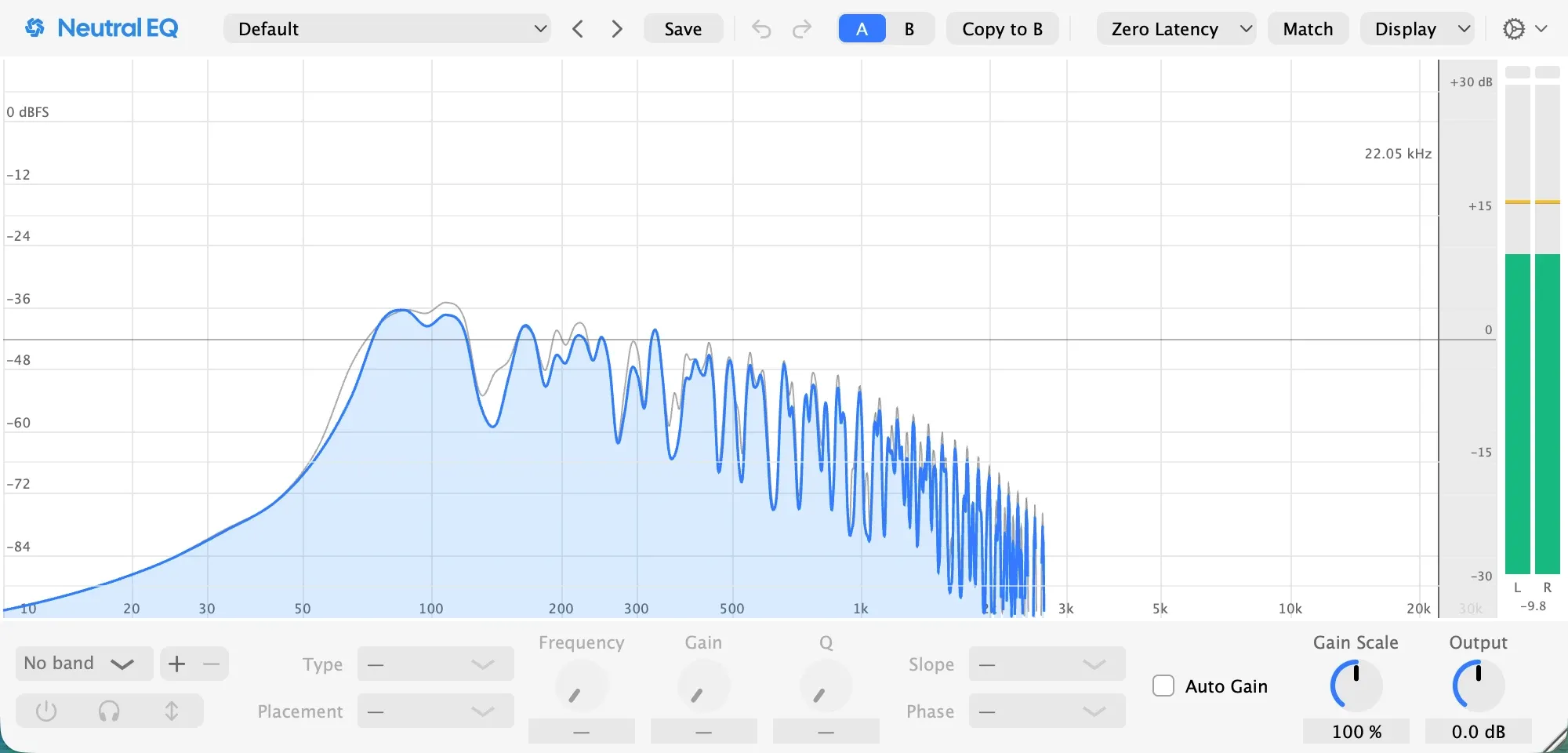
Decide the low end with the kick
In a digital session the bass is a synth or a sample, and its first fight is not with EQ but with the kick: both want the lowest octave. Decide who owns it before any band. On this session the kick’s note falls to 52 Hz and the bass plays between 73 and 110 Hz, so the kick owns the sub and the bass sits above it. When an 808 is the bass, the roles flip and the kick page says how.
What you are hearing
A bass line has four regions, and the picture above shows them. The note is 40 to 120 Hz, the thing you feel. The mud is 200 to 300 Hz, where the harmonics pile up and the bass blurs into the pad and the guitars. The definition is 700 Hz to 1.5 kHz, the harmonics that carry the line on a phone, where the note itself cannot be heard. On a bass guitar there is a fourth region, the fingers and the pick between 2 and 4 kHz.
1. Give the kick its pocket
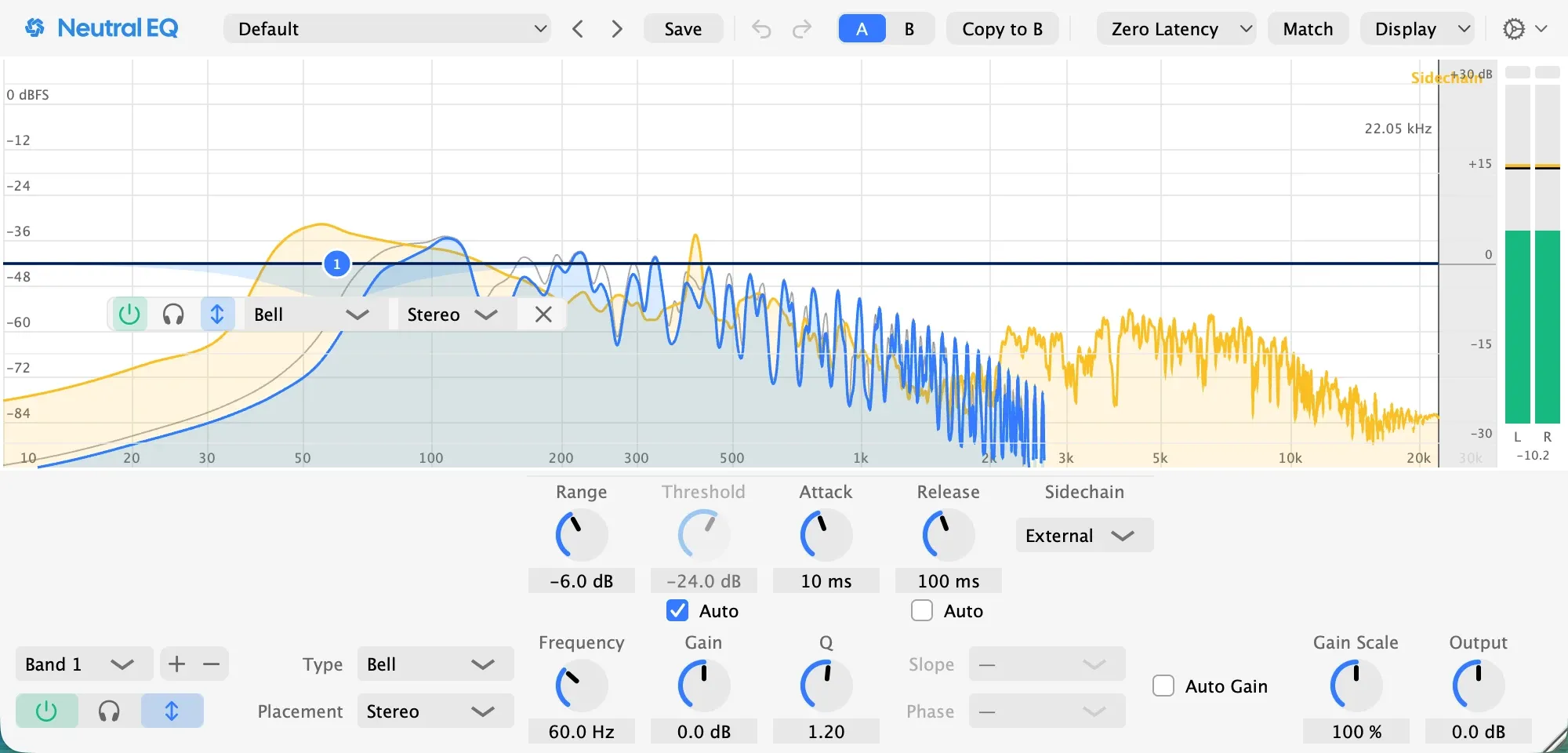
Route the kick to the EQ’s sidechain input and make the first band dynamic: a bell at the kick’s note, 60 Hz here, with its gain at zero and a dynamic range of six decibels, listening to the sidechain. The bass ducks only where the kick sits and only while the kick hits, and comes back the moment it is gone. That is the pocket, and it does more for a low end than any static cut. The display draws the kick as a second trace so you can see the two meet.
Pro tip: when the 808 is the bass, give it the pocket’s other half: a short kick that sits above the 808’s note, and the 808 left whole. Ducking the 808 under the kick is the usual move there, with a sidechain compressor rather than a band.
2. Cut below the note gently, or not at all
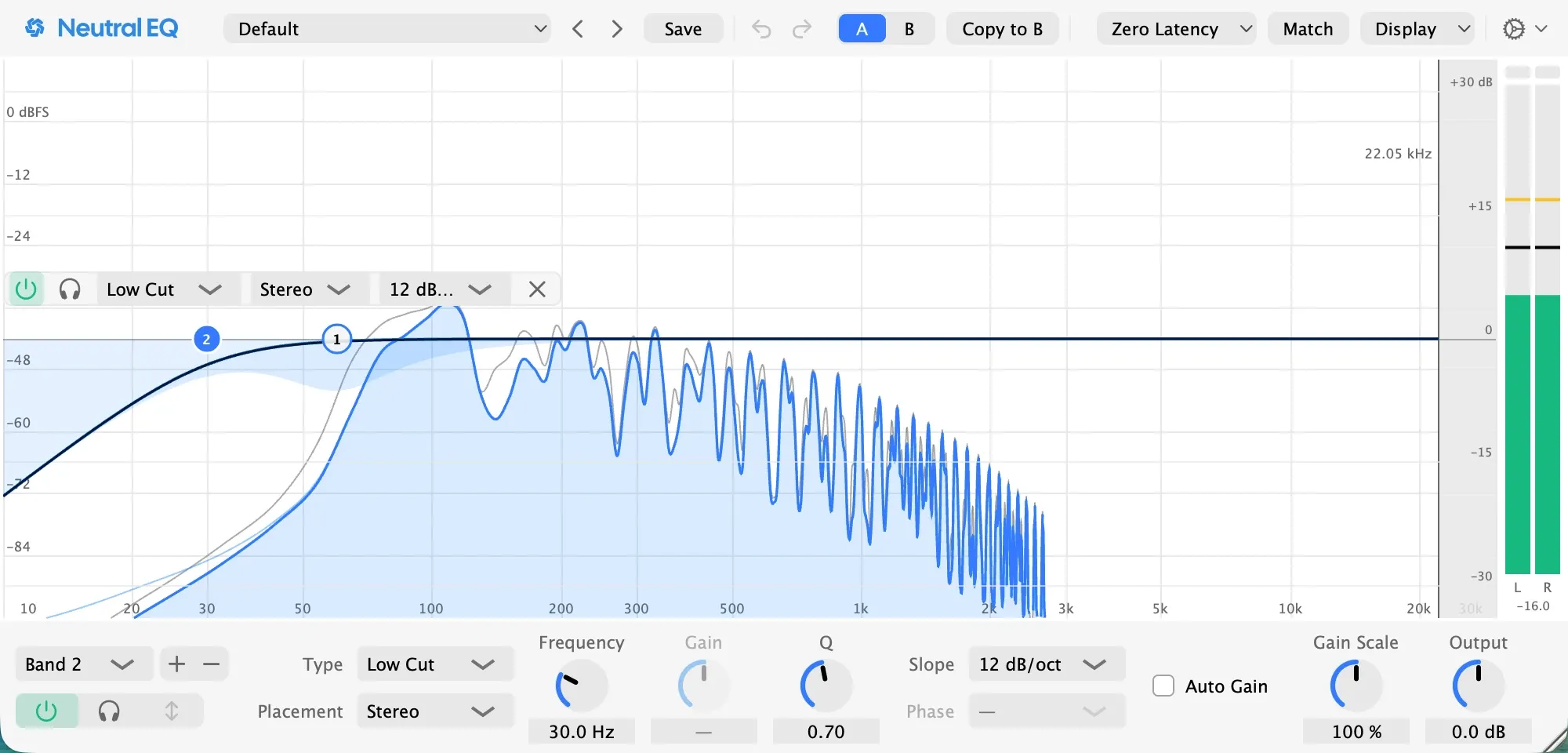
A low cut at 30 Hz with a gentle 12 dB per octave slope removes what no speaker plays and keeps every note whole. On a sub bass or an 808 whose lowest note is near 40 Hz, leave it off: a cut near the note bends the phase around it and softens the bottom, and if a cut must sit that close, linear phase is the mode for it.
3. Cut the mud
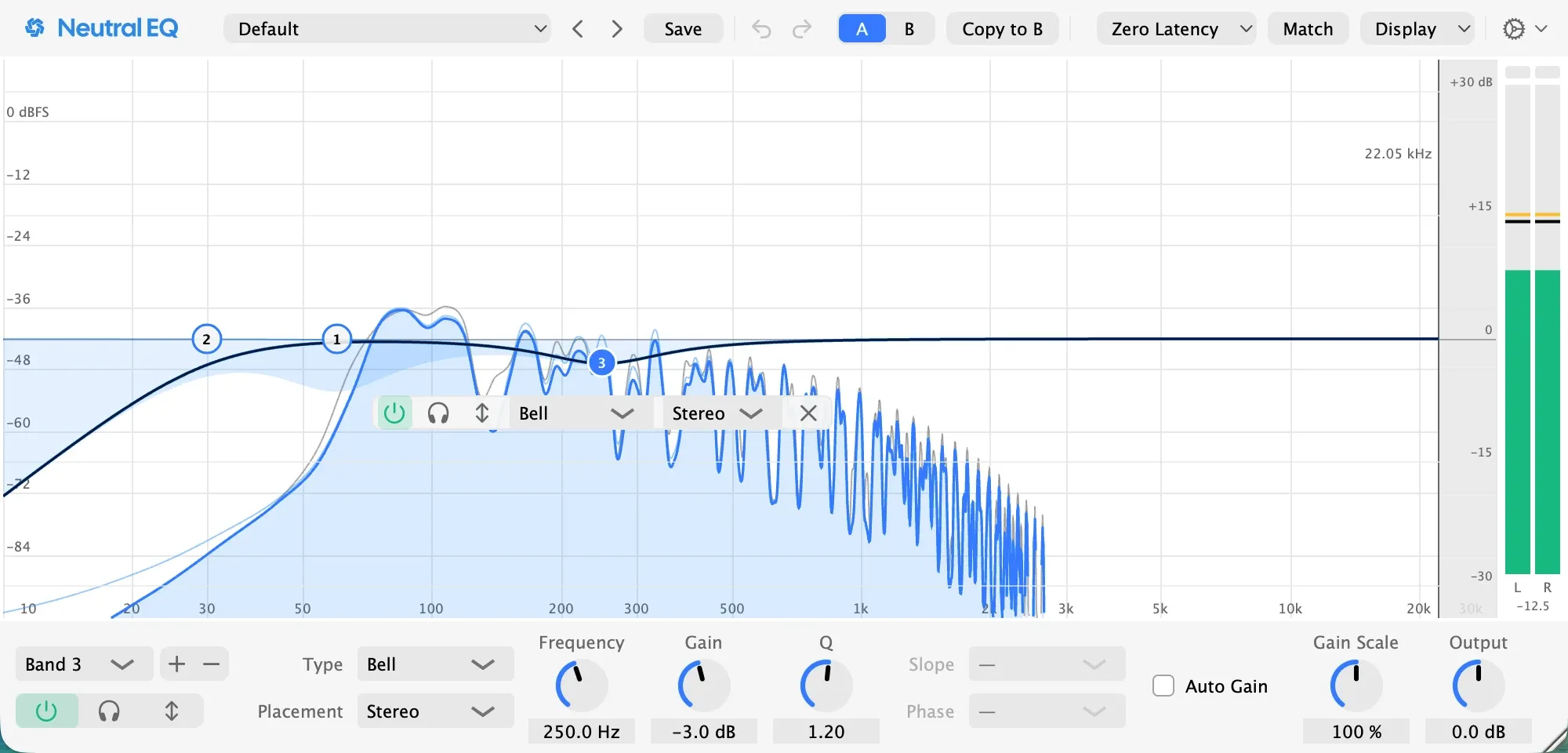
Sweep a narrow boost between 150 and 400 Hz while the line plays with the kick. Where the bass turns thick and shapeless, stop; on this session it was 250 Hz. A cut of two to four decibels there, here three with a Q of 1.2, is the one move that makes a bass line clear without making it thin, and it clears the range the pad and the guitars want.
Pro tip: if the mud comes only on the low notes, make the cut dynamic, so it acts on those notes alone.
4. Make the line heard on small speakers
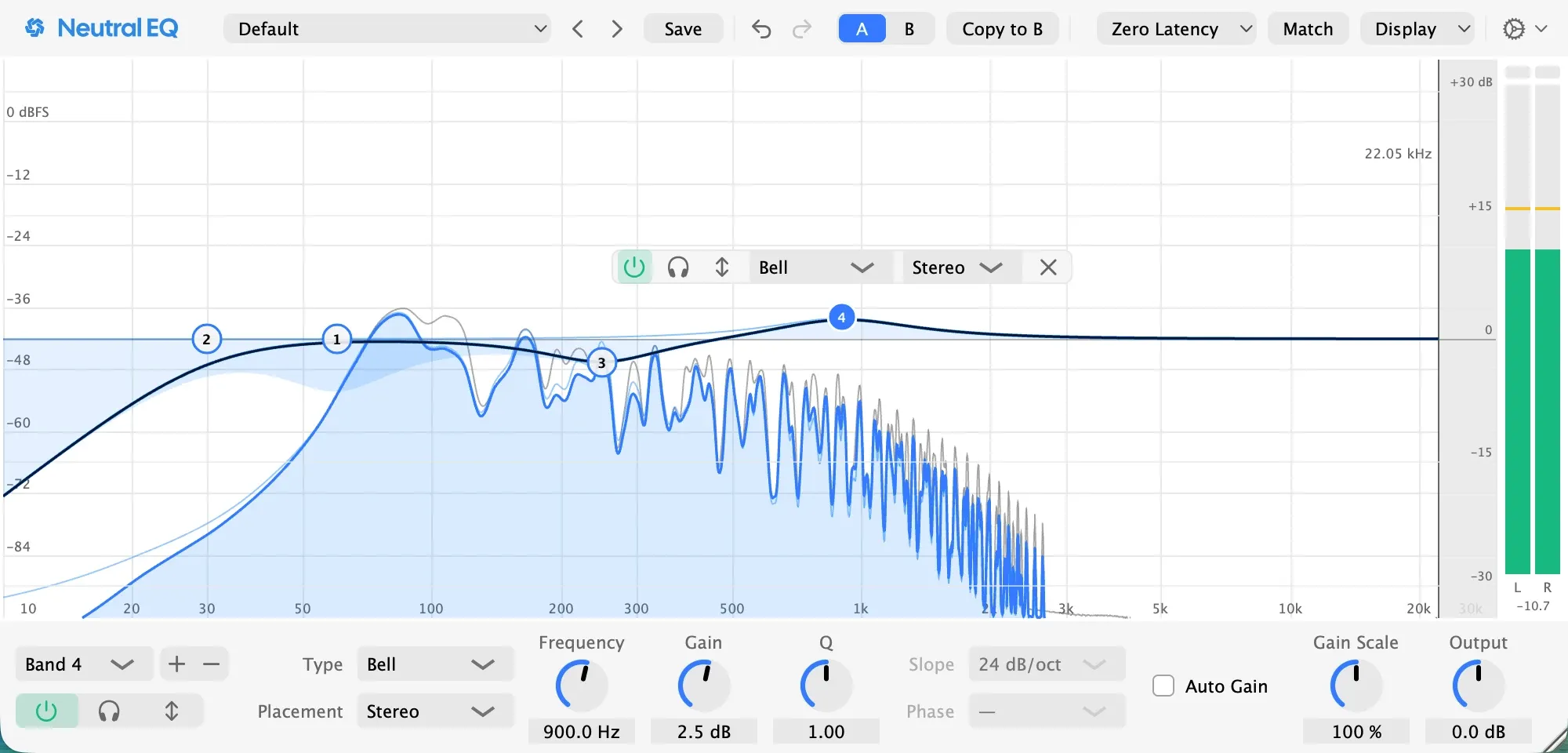
A phone plays none of the note. What it plays is the harmonics, so a lift of two or three decibels near 1 kHz, here two and a half at 900 Hz with a Q of 1, is how a listener there follows the line at all. On a synth bass the drive or harmonics control is the better tool for this, because it makes harmonics where EQ can only lift the ones that exist; use the band when the sound has them and the mix hides them.
Check it
Play it on the smallest speaker you own: the line should be followable without the note. Then play it with the kick on a system that has a sub: the two should take turns, never blur. If they fight, go back to step 1 rather than adding bands.
Pro tip: judge at matched level, with Auto Gain on, and by switching the band off in the full mix rather than soloing it.
If it was a bass guitar
Same four moves, with the fingers added. A direct recording has a weaker fundamental than a synth, so the Bass Sub Focus preset’s shelf is often the fifth move, and the low cut sits at 40 Hz rather than 30. The fingers and the pick live between 2 and 4 kHz: a small lift there is the bass guitar’s version of step 4, and a cut there is how a bass stops competing with a vocal.
In Neutral EQ
The Bass folder holds this page’s moves: Bass Kick Pocket is step 1 as a dynamic band keyed from the sidechain, Bass Clean-Up is the low cut and the mud cut together, Bass Note Definition is step 4, and Bass Sub Focus is the shelf for a thin fundamental. Load one, route the kick to the sidechain where a preset needs it, and the analyzer with Note Names on shows the bass’s note and the kick’s as letters, so the two can be set an octave or a fifth apart on purpose. The presets page lists the folder.
Going further
Keep the bass mono below 120 Hz. A widened synth bass turns to mush on a club system and vanishes on a phone; the Low End Mono preset keeps the note in the centre and leaves the top wide.
EQ the other sounds out of the bass’s way. A low cut on the pad and the guitars, which how to EQ shows, does more for the bass than any lift on the bass.
Tune the low end to the key. A sub bass or an 808 is a pitch; set it to the song’s key with Note Names on, and the kick a fifth or an octave away, before any band.
Questions people ask
How do I make bass sit in a mix?
Give the kick and the bass each their own place in the lowest octave, and let the bass step aside on each kick hit with a dynamic band keyed from the kick. Then cut the mud between 200 and 300 Hz, which is where a bass blurs into everything else, and lift the harmonics near 1 kHz so the line is heard on small speakers.
What are good bass EQ settings?
There are no settings, only moves: a dynamic cut at the kick's note keyed from the kick, a gentle low cut near 30 Hz or none on a sub bass, a cut of two to four decibels where the sweep finds the mud, and a lift of two or three decibels near 1 kHz. The numbers on this page are the ones that worked on this session.
Should the kick or the bass be lower?
Either, as long as it is decided. In most electronic mixes the kick owns 50 to 70 Hz and the bass sits above it; in hip-hop and trap the 808 is the bass, owns everything under 60 Hz, and the kick is a short punch above it. Pick one, then EQ both toward it.
Related pages
Made in Neutral EQ on a session built for this page: a drum machine kick and a synth bass in Neutral Tracks, the kick sent to the EQ's sidechain input, the EQ on the bass. Every picture is the plugin as it was set for that step.