EQ
What EQ does in music
EQ, short for equalization, turns one range of frequencies up or down inside a sound: less boom in a kick, less box in a pad, more air on a vocal. It changes the balance inside a sound, not its loudness, so that when sounds play together each one is heard.
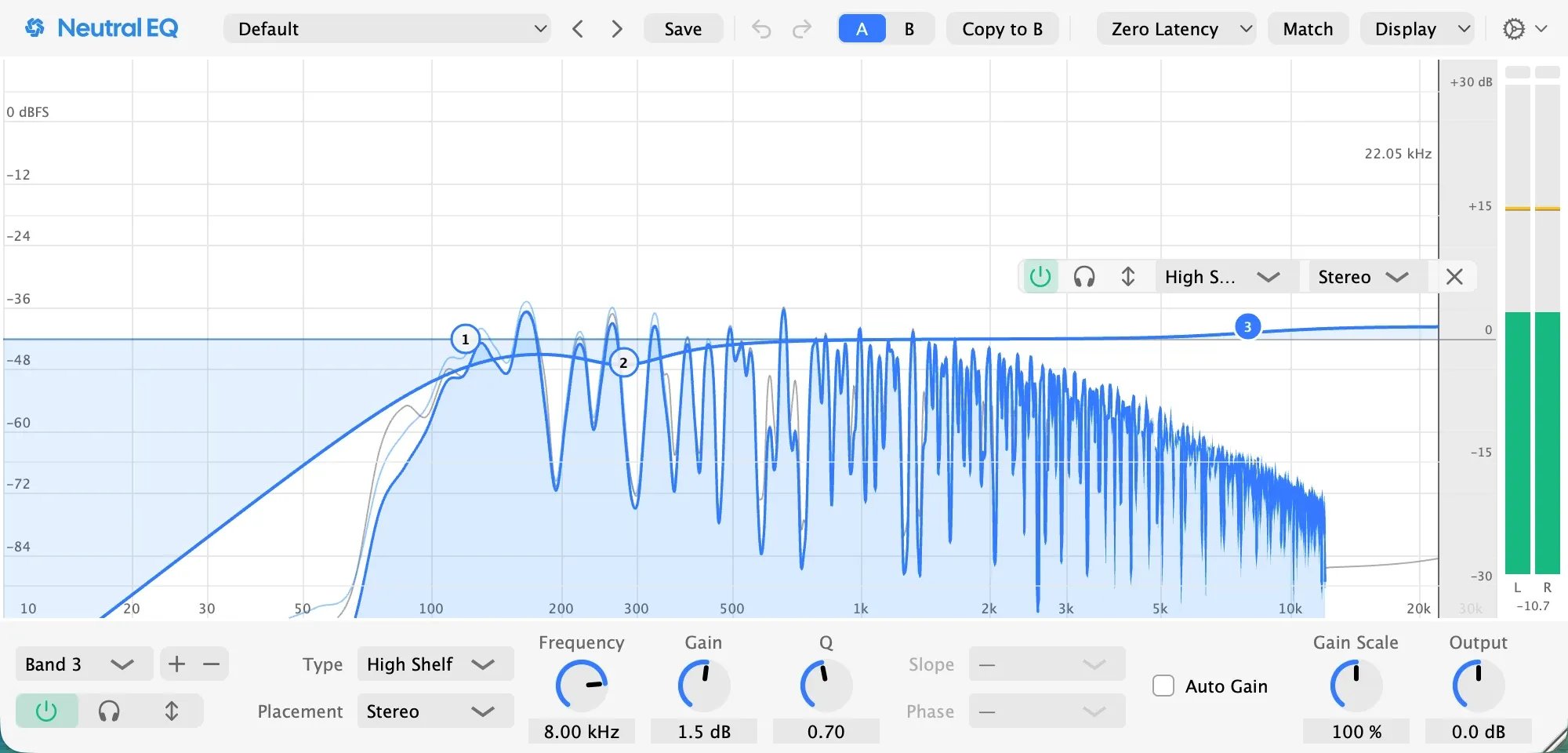
What EQ is
Every sound is a stack of frequencies, from the lowest rumble to the highest hiss. An EQ picks one range and turns it up or down. One move is a band, and a band has three controls: a frequency, where it acts; a gain, how much and whether up or down; and a width, called Q, how wide a range it reaches. A parametric EQ, which every plugin EQ is, lets you set all three for each band and draws the bands as dots on a curve, so the shape you see is the shape you hear.
Three kinds of move cover most of what an EQ is for, and the picture above shows all three on a pad:
- A cut takes something away: the box in a pad, the boom under a voice recorded in a small room, the ring in a snare.
- A boost brings something forward: the air above a vocal, the click of a kick.
- A shelf tilts a whole end of the sound: a little less of everything below a point, or a little more of everything above one.
What it changes, and what it does not
EQ changes the balance inside one sound. It does not change loudness as a whole, which is a compressor’s job, and it does not change pitch. A good EQ also changes nothing you did not touch: the ranges outside your bands come through as they went in. Neutral EQ’s own claim is that it adds nothing but the curve, and the measurements behind that are on its page.
When EQ helps
- A sample carries something the part does not need. A kick with a cardboard knock in its shell, a pad with sub under it, a loop recorded in a boxy room. A cut takes it out.
- Two sounds sit in the same place. The kick and the bass in the lowest octave, a pad on top of the bass, two guitars in the same range. EQ gives each its own spot, and a small cut on one is worth more than a boost on the other.
- A sound is harsh in the mix but fine alone. A synth lead or a cymbal that bites at two or three kHz when everything plays. A cut there, found with a sweep, is the usual fix.
- A sound is dull next to the others. A vocal or a lead that needs air. A wide shelf of a decibel or two, last, after the cuts.
- A recording brought its room along. A microphone hears the room’s resonances as well as the sound; a cut on each one, found with a sweep, is the standard repair.
One move to try
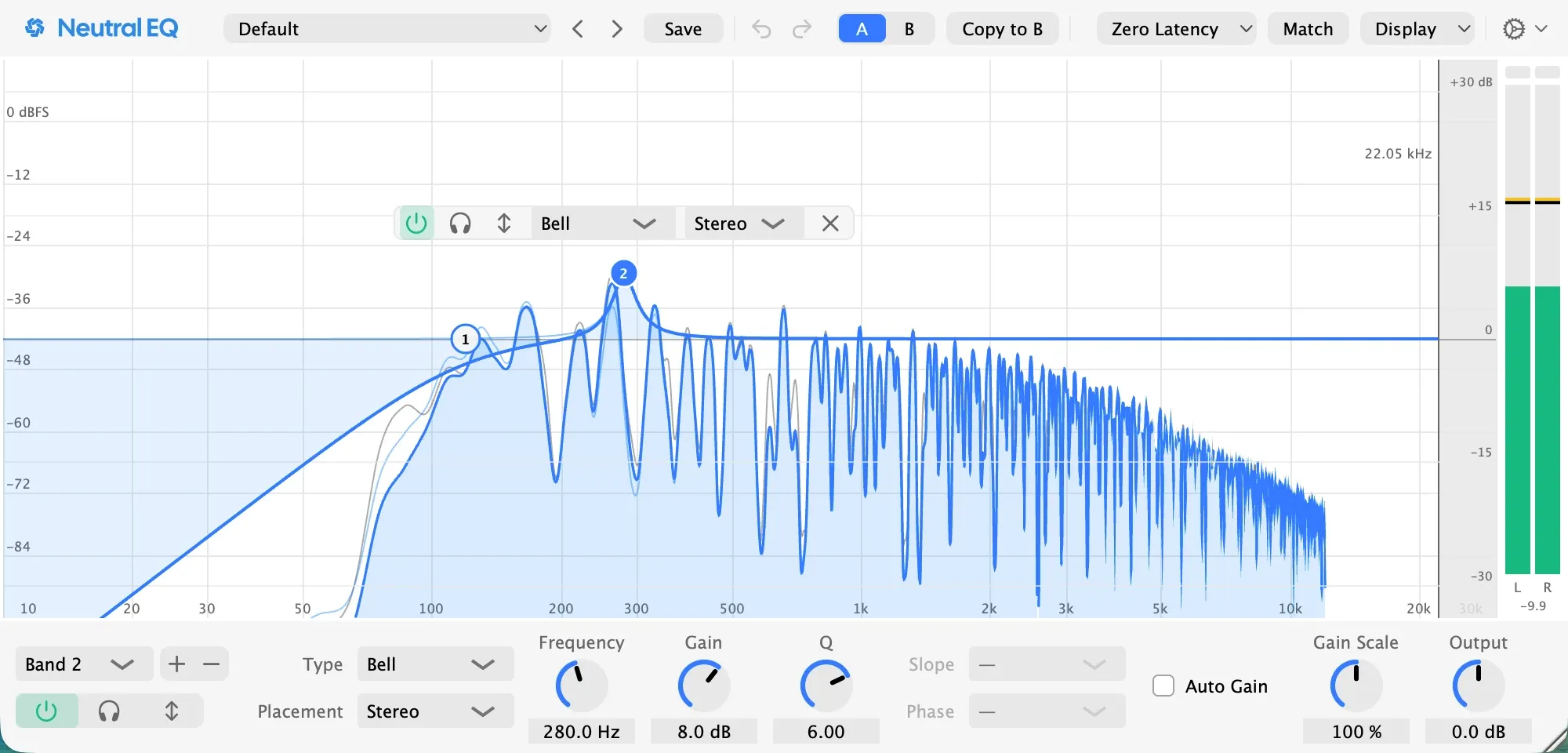
Play the sound in the mix, make a narrow band, boost it eight decibels, and sweep it slowly until the thing that bothers you jumps out. Turn the boost into a cut of two or three decibels, widen it, and listen with everything on. That one move, the sweep, is most of EQ; the rest is knowing where each instrument’s trouble usually sits, which how to EQ and the instrument pages cover.
Going further
A band can act only when it is needed. A dynamic band cuts or lifts only while the sound crosses a level, so a box that shows on loud hits alone is cut on those alone.
Centre and width can be shaped apart. Mid and side placement lets a band act on what sits in the middle of the stereo picture, or only on what sits at the sides.
An EQ bends phase, and sometimes that matters. Every ordinary EQ shifts the timing of the frequencies it touches a little; linear phase does not, at a cost in latency, and is worth it in a few places.
Questions people ask
What does EQ stand for?
Equalization. The word comes from telephone lines, where an equalizer made a long line's highs and lows arrive at equal strength again. In music the job turned around: an EQ makes a sound unequal on purpose, so each instrument has its own place.
What does EQ do to a song?
On one sound it turns a range of frequencies up or down. Across a song it gives each sound its own place, so the kick and the bass do not blur, the pad does not sit on the bass, and the vocal is heard over everything without being louder.
Is EQ the same as a compressor?
No. EQ changes the balance of frequencies inside a sound; a compressor changes how loud the sound is from moment to moment. A sound that is boomy needs EQ. A sound that is loud one bar and quiet the next needs a compressor.
Related pages
Made in Neutral EQ on a session built for this page: a drum machine beat, a synth bass and a pad in Neutral Tracks, the EQ on the pad. Every picture is the plugin as it was set.