EQ
Mid/side EQ explained
Mid/side EQ splits a stereo sound into its centre and its width and lets a band act on one: a low cut on the sides keeps the kick and the bass in the middle, a lift on the sides adds air without touching the vocal. In Neutral EQ any band can be placed on the mid, side, left or right.
What mid and side are
Two speakers play two signals. What they share is the mid, the centre of the picture: a vocal, a kick, a bass, anything panned to the middle. What they do not share is the side, the width: a wide pad, a stereo reverb, a doubled guitar panned apart. Any stereo sound can be split into the two and put back together without loss, and a mid/side EQ lets a band act on one half. In Neutral EQ that is a placement on the band, Stereo by default, Mid or Side by choice, with Left and Right beside them for a lopsided sound.
What it changes
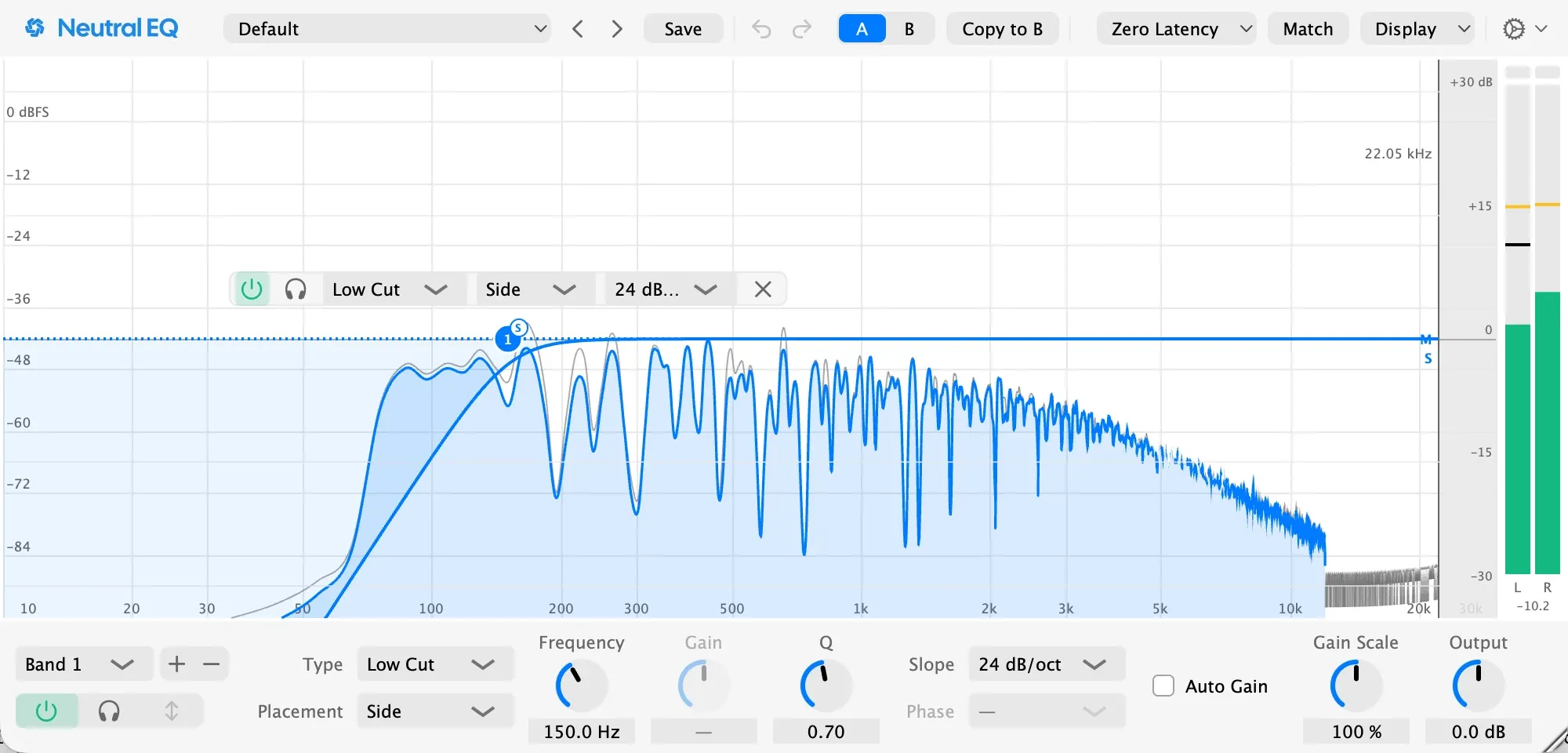
A band placed on the side cuts or lifts the width and leaves the centre as it was, so a vocal in the middle hears nothing of it. A band placed on the mid does the reverse. The picture above is a low cut placed on the sides of a wide pad: everything the pad spreads across the stereo field loses its lows, while the kick and the bass in the centre lose nothing, because the band never touches the centre.
When it helps
- Lows that should be mono. A widened pad, a chorus on a bass, a stereo sample with low end on its edges. A low cut on the side between 100 and 200 Hz keeps the bottom in the centre, which is where a club system and a phone can play it.
- Air without brightening the vocal. A high shelf on the side lifts the edges of the picture and leaves a centred vocal alone.
- A reverb or a pad that clouds the middle. A cut on the side where it clouds, so the width thins and the centre stays full.
- One side louder than the other. A band placed on the left or the right, the same idea with the halves swapped, for a sample recorded off-centre.
- Making room in the centre. A small cut on the mid where a vocal lives, on a wide pad or a doubled guitar, so the words come through the middle while the width keeps its tone.
One move to try
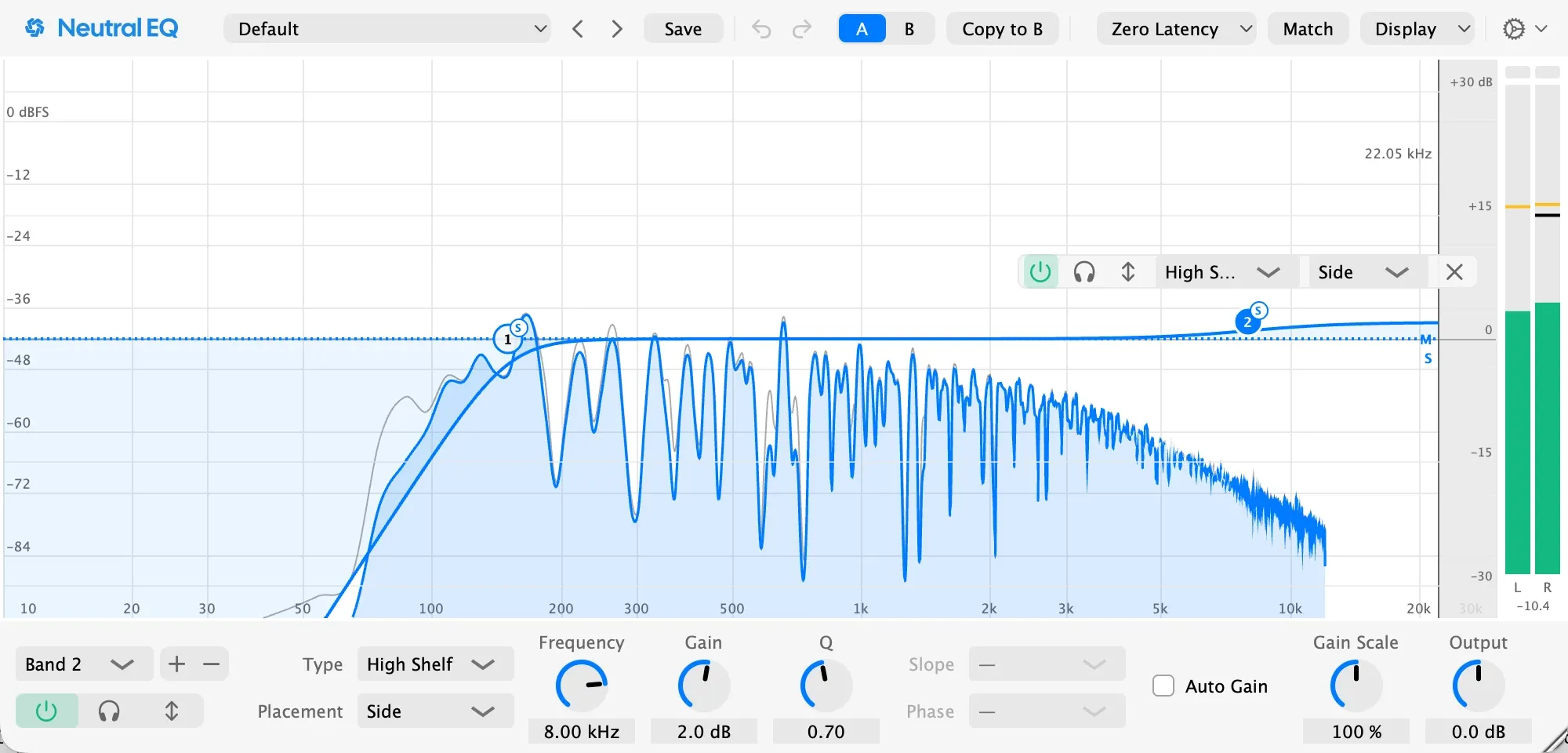
On any wide sound, place a low cut on the side near 150 Hz and listen with the beat: the pad gets narrower in the bass and no quieter, and the kick and the bass come forward. Then place a shelf of a decibel or two above 8 kHz on the side: the edges open up and a vocal in the middle hears none of it. Those two bands are most of what mid/side EQ is for.
Going further
The placement is in the band’s strip. The Placement popup on each band chooses Stereo, Left, Right, Mid or Side, and a band wears its letter on the curve, so a page like this one reads at a glance which bands act where. The bands page covers it.
Two presets are these moves. Low End Mono is the side low cut and Side Air is the side shelf, in the Utility and Master folders; load one and drag its band to where your sound wants it.
It is a small move on a mix. On a master a side cut or lift is a decibel or two; more than that changes the picture rather than cleaning it, and the fix for a lopsided mix is the pan knobs, never a band.
Questions people ask
What is mid/side EQ?
A way of placing a band. A stereo sound is the sum of what the two speakers share, the mid or centre, and what they do not, the side or width. A band placed on the mid acts on the centre alone, on the side on the width alone, so a cut can tighten the width without touching a vocal in the middle, or add air to the edges without brightening it.
When should I use mid/side EQ?
When the centre and the width need different things: lows on the sides that should be mono, air that the edges want and the vocal does not, a reverb or a wide pad that clouds the middle. On a mono sound it does nothing, and on a mix it is a small move, a decibel or two, never a rebuild.
Is mid/side EQ a separate plugin?
Not here. In Neutral EQ every band has a placement, Stereo, Left, Right, Mid or Side, so one band on the side of a stereo track is a mid/side move and the rest of the bands stay where they were.
Related pages
Made in Neutral EQ on a session built for this page: a drum machine beat, a synth bass and a pad made wide in Neutral Tracks, the EQ on the pad. Every picture is the plugin as it was set.