EQ
Linear phase EQ: when to use it
An ordinary EQ shifts the timing of the frequencies it touches a little; a linear phase EQ does not, at the cost of latency and a faint ring before sharp hits. Use it where timing matters: a steep cut near a kick's note, a master, two paths of one sound summed. The ordinary kind everywhere else.
What phase has to do with EQ
Every ordinary EQ changes two things at once: how loud each frequency is, which is the curve you see, and when each frequency arrives, which you do not see. The timing shift is small and grows where the curve is steep, which is why a gentle shelf is harmless and a 48 dB per octave low cut near a kick’s note is not. That ordinary kind is called minimum phase. A linear phase EQ applies the same curve and leaves every frequency’s timing where it was, and pays for it twice: with latency, which your DAW compensates, and with a faint ring that arrives before a sharp hit when the curve is steep in the lows.
What you are seeing
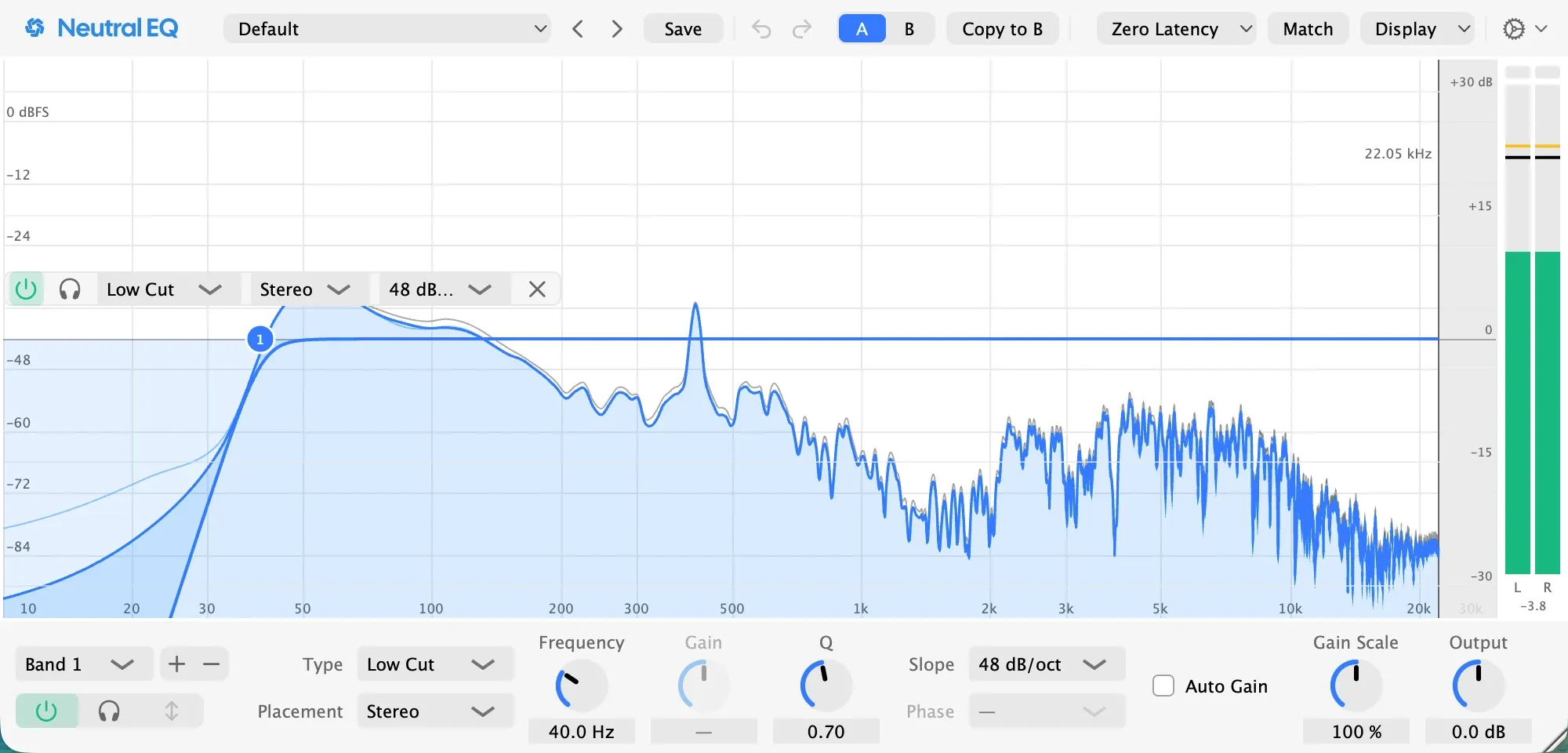
The picture above is a steep low cut at 40 Hz, 48 dB per octave, sitting an octave under this session’s kick, in Zero Latency: the ordinary kind, with no delay. The curve is the same in every mode. What changes between modes is the timing behind the curve and the latency the top bar shows beside the mode’s name.
When it helps
- A steep cut close to a note. A low cut within an octave of a kick’s or a bass’s note bends the phase around the note and softens the hit in the ordinary mode. Linear phase keeps the hit; its pre-ring is the price, and a gentler slope is often the better fix.
- A master. Small moves on a whole mix, where a timing shift between the bass and the rest can be heard as a loss of punch; a linear phase shelf or two leaves the transients alone.
- Two paths of one sound. Parallel processing, a sound split across two tracks, several microphones on one source: an ordinary EQ on one path shifts its timing against the other and the sum thins out where they disagree. Linear phase keeps the paths aligned.
- Not for recording or playing live. The latency is real; the ordinary mode is for anything a player hears while playing.
- Not for a vocal, a guitar or a pad. The ordinary mode is what every record you know was mixed with, and the pre-ring buys nothing on a sound without sharp hits in the lows.
One move to try
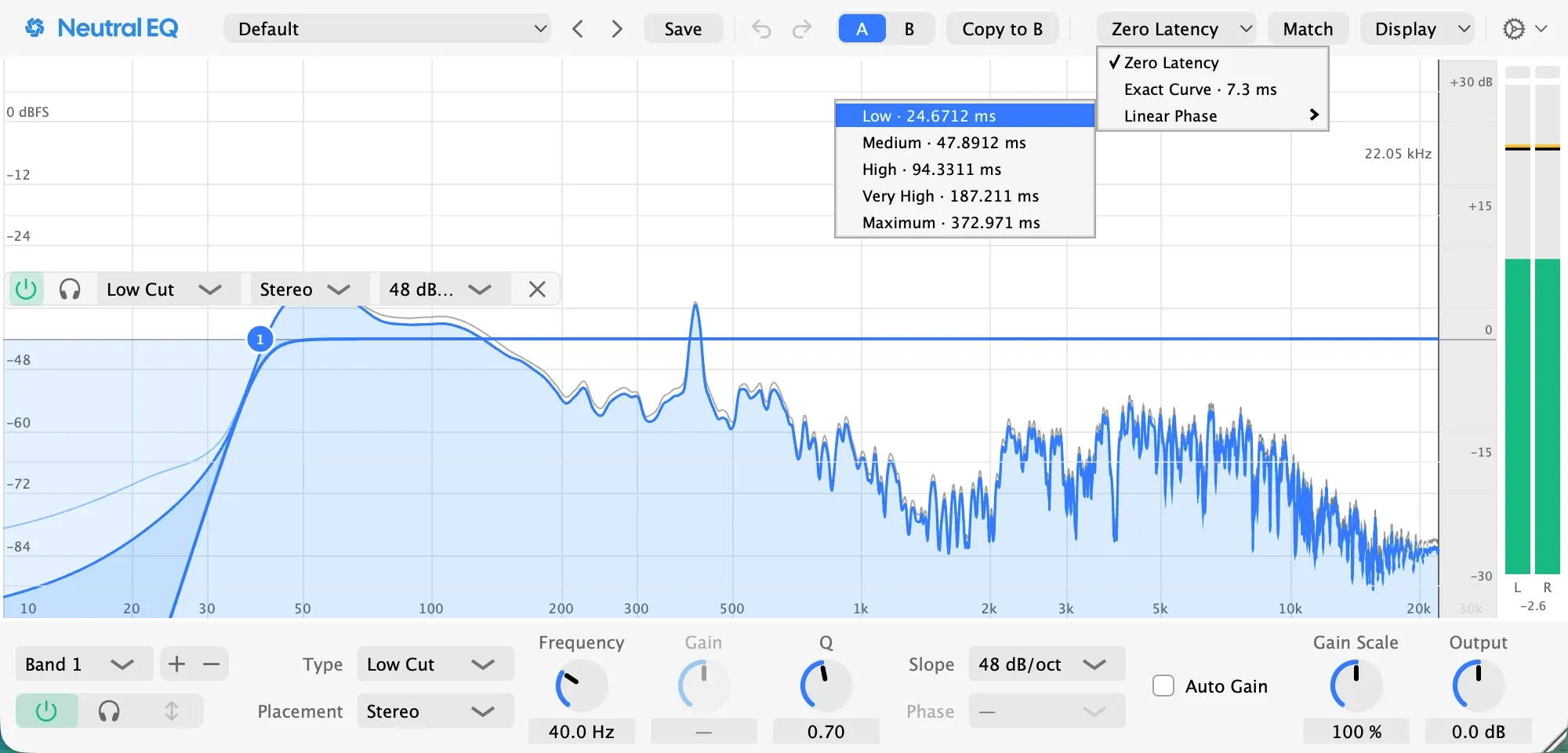
Put a steep low cut an octave under a kick’s note, play the loop, and switch the mode from Zero Latency to Linear Phase in the top bar’s mode menu, where each choice shows its latency at your session’s rate. The curve does not move. Listen to the hit: in the ordinary mode it is a touch softer than the dry kick, in linear phase it keeps its edge and a faint pre-ring appears on the biggest hits. Then widen the slope to 12 dB per octave in the ordinary mode and listen again; on most kicks that is the right answer, and the mode stays at zero latency.
Going further
Three modes, one curve. Neutral EQ’s modes are Zero Latency, the ordinary kind with none; Exact Curve, the analog shape and phase at every sample rate for about seven milliseconds at 44.1 kHz; and Linear Phase, with its latency set by the Resolution choice.
Linear phase per band. Under Linear Phase each band has a Phase choice, Linear or Natural, so a low shelf can keep its timing while the bells above it keep an analog filter’s, with no pre-ring where it would be heard.
Resolution is a trade. A longer setting resolves low frequencies more exactly and adds more delay; it is a setup choice, not something to automate, because changing it changes the plugin’s latency.
Questions people ask
What is the difference between linear phase and minimum phase EQ?
A minimum phase EQ, the ordinary kind, shifts the timing of the frequencies it changes by a little, more where the curve is steep; it has no latency and no ring before a hit. A linear phase EQ keeps every frequency's timing, which costs latency and puts a faint ring before a sharp hit when the curve is steep in the lows. Same curve, different timing.
When should I use linear phase EQ?
When the timing shift would be heard: a steep cut close to a kick's or a bass's note, a master where small moves must leave the mix's transients alone, and any place where two paths of one sound are mixed back together, such as parallel processing or several microphones on one source. Everywhere else, the ordinary mode is the better sound and has no delay.
Does linear phase EQ sound better?
No; it sounds different in one way, the timing, and that is worth it in the few places where timing matters. On a steep low cut on a kick the pre-ring can be heard as a softening of the hit, and on a vocal or a guitar the ordinary mode is what every record you know was mixed with.
Related pages
Made in Neutral EQ on a session built for this page: a drum machine kick and a synth bass in Neutral Tracks, the EQ on the kick. Every picture is the plugin as it was set.